Your IT Glue ROI Problem: Docs Nobody Reads
By ResolvCmd
IT Glue is a solid documentation platform. If you’re an MSP, there’s a good chance you’re paying $29-45 per user per month for it. You’ve invested time building out your knowledge base — SOPs, procedures, client configurations, network diagrams.
And yet your senior technicians still spend half their day answering questions that are documented somewhere in IT Glue.
This isn’t an IT Glue problem. It’s a workflow problem. And understanding it is the first step to fixing it.
The documentation utilization gap
Here’s the pattern we see across MSPs of every size:
The documentation exists. It’s well-organized. It’s even up to date. But when a ticket comes in, the technician’s natural workflow doesn’t include a stop at IT Glue. They open the ticket, read the issue, and either solve it from memory or ask someone who can.
Searching IT Glue requires context-switching: leave the ticket, open IT Glue, figure out what to search for, scan through results, find the right article, read through it, go back to the ticket, apply the steps.
That’s a lot of friction for a Level 1 technician who’s trying to hit their SLA targets. So they take the shortcut: they Slack the senior tech.
Waste cycle
Docs written
SOPs exist in IT Glue / Hudu
Ticket arrives
Issue needs resolution
Team member searches
Context switch to docs
Can't find it
Wrong keywords, too many results
Asks senior tech
23 min recovery per interruption
Resolves from memory
Docs unused, knowledge stays tribal
Docs written
SOPs exist in IT Glue / Hudu
Ticket arrives
Issue needs resolution
Team member searches
Context switch to docs
Can't find it
Wrong keywords, too many results
Asks senior tech
23 min recovery per interruption
Resolves from memory
Docs unused, knowledge stays tribal
Cycle repeats
The real cost
This isn’t just a documentation problem. It’s an economic problem:
- Senior technician time — Your most expensive team members become human search engines instead of handling complex escalations
- Resolution time — Tickets sit waiting for the senior tech to respond, blowing your SLA metrics
- Inconsistency — Different technicians resolve the same issue differently depending on who they asked and when
- Onboarding — New hires take months to become productive because they can’t self-serve from the knowledge base
- Knowledge loss — When a senior tech leaves, their tribal knowledge goes with them despite being “documented”
Why more documentation doesn’t help
The instinct is to create more documentation, better documentation, or to reorganize IT Glue. Some MSPs even assign documentation champions or create documentation mandates.
None of this addresses the core problem: the documentation isn’t in the workflow. It’s a reference library, not an active participant in ticket resolution.
Adding more books to a library that nobody visits doesn’t increase readership.
What actually works: documentation in the workflow
The solution isn’t better documentation. It’s better delivery.
Your documentation needs to show up automatically, inside the ticket, matched to the specific issue being reported. The technician shouldn’t need to search for it, navigate to it, or even know it exists.
This is what a resolution engine does. It connects your IT Glue instance (or Hudu, Confluence, Google Drive) to your ticketing system and delivers structured, source-linked resolutions right where your team works.
When a ticket about a VPN issue arrives, the resolution engine has already matched it against your VPN SOPs and produced step-by-step instructions before the technician opens the ticket. Each step links back to the specific IT Glue article it came from.
Measuring the difference
If you want to quantify the documentation utilization gap in your MSP, track these metrics:
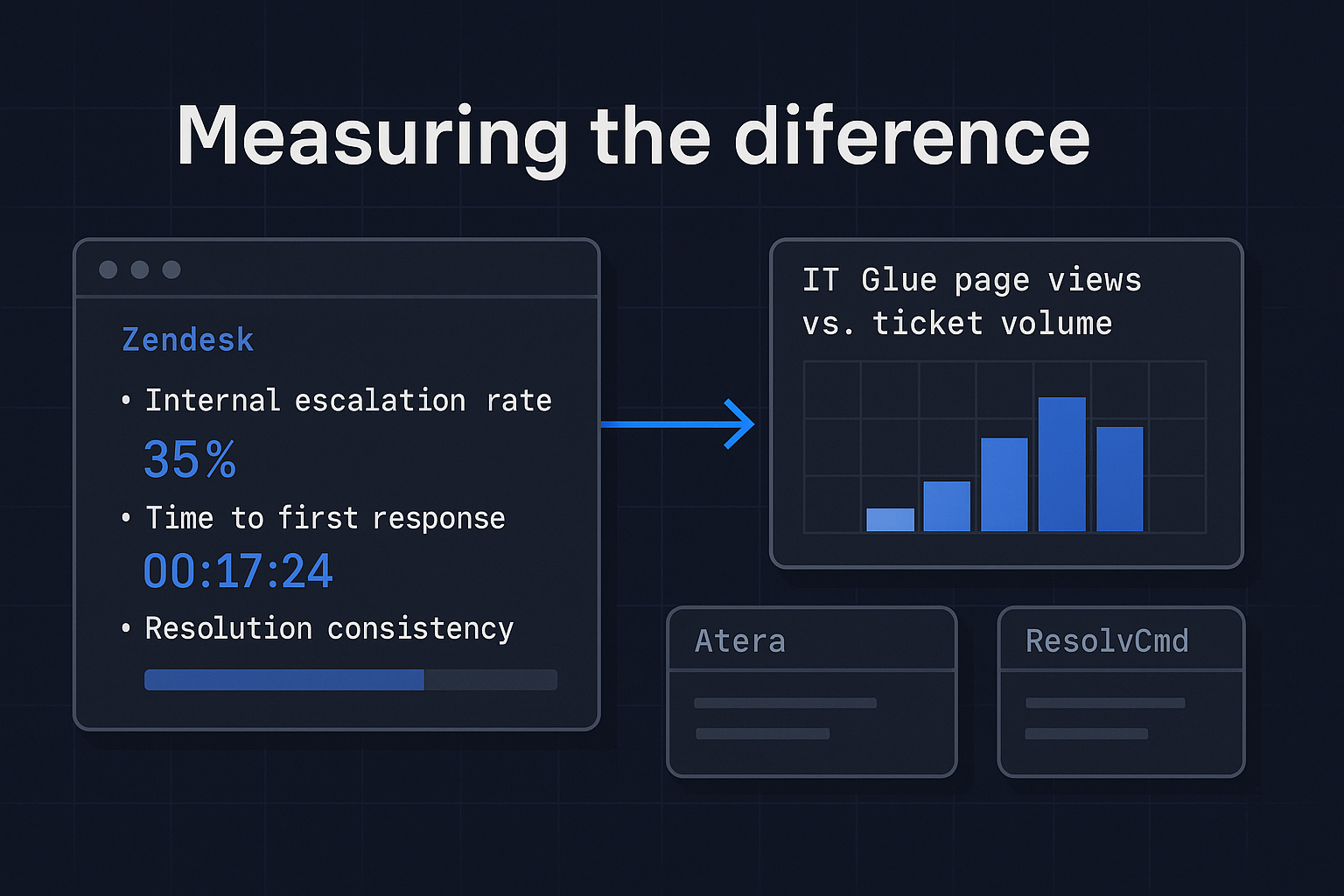
- Internal escalation rate — How often do L1 tickets get escalated or deferred to a senior tech?
- Time to first response — How long between ticket creation and the first meaningful action?
- Resolution consistency — For the same ticket type, do different technicians produce the same resolution?
- IT Glue page views vs. ticket volume — Are your docs being viewed proportional to your ticket volume?
If your escalation rate is above 30%, your time to first response exceeds your SLA, and your IT Glue views are flat while ticket volume grows — your documentation investment isn’t delivering ROI.
The path forward
You don’t need to replace IT Glue. You need to activate it. Connect it to where work actually happens — inside the ticket — and let the documentation work for you instead of waiting to be found. If you’re also running Zendesk, see how teams are connecting IT Glue documentation to Zendesk tickets.
Your $29-45/user/month investment in documentation should be delivering value on every ticket, not sitting unused while your team builds parallel knowledge channels in Slack.
Ready to turn your documentation into instant resolutions?
Start Free TrialMore in MSP Operations
MSP AI Service Desk Landscape 2026: Pia, Neo Agent, Helena, Zofiq, and the Question of Autonomy
A working map of the MSP AI service desk landscape in 2026. RPA-flavored automation (Pia), full-autonomy agents (Neo Agent), PSA-bundled AI (Helena AI / DeskDay), ConnectWise's native acquisition (Zofiq), and where each fits.
Best AI Apps for Zendesk IT Teams in 2026
Most Zendesk AI app lists focus on customer support chatbots. This one is for IT teams and MSPs using Zendesk for internal technical support. We cover 8 AI apps that actually handle documentation, SOPs, and structured ticket resolution.